DSOs generate an enormous amount of operational data every day. But which numbers matter? Is leadership aligned on them? And which initiatives are worth spending time (and money) on? That's exactly where AI is starting to change how dental enterprises lead.
At the Overjet AI Summit 2026, Bailee Case, Enterprise Customer Success Manager (CSM) at Dental Intelligence, sat down with Jody Erickson, Director of Practice Growth at Bridge Dental Group, to talk about how Bridge uses Explorer, Dental Intelligence's conversational AI tool, to answer those questions across more than 30 locations. With Explorer, DSO leaders can ask questions about their practice data in plain English and get answers, forecasts, and goals in seconds, all within a HIPAA-compliant, SOC 2 certified platform. Jody shared three everyday examples, then walked through how a single conversation with Explorer can take a metric from raw data to an impactful, achievable plan.
*Note: the figures shared in the session, and in this recap, are based on example data.
Example 1: Identify the Most Urgent Focus Areas by Role
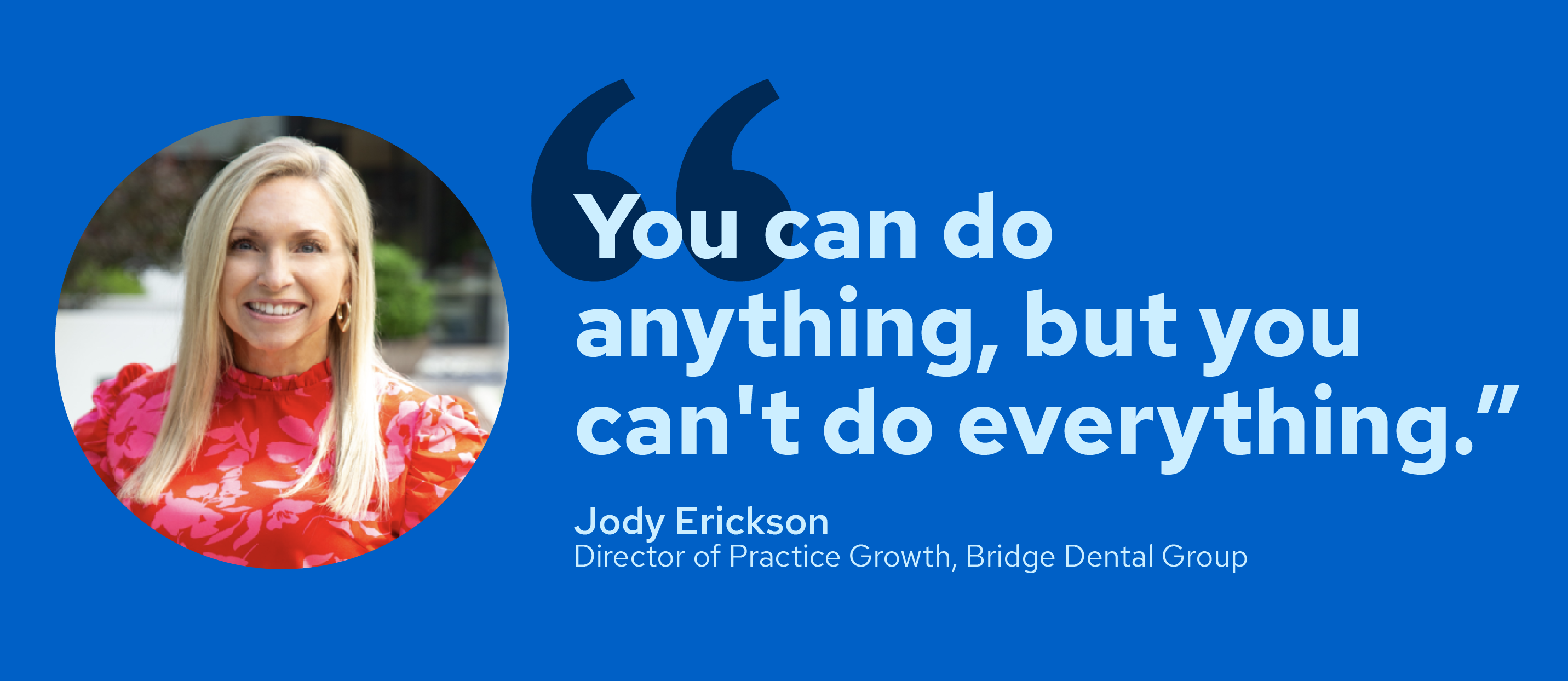
When you have over 30 practices, how can you know which one needs you today? Jody has a saying: “You can do anything, but you can't do everything.”
Her starting question to Explorer was simple: “Which practice needs my attention as Director of Practice Growth?” By including her title and the area she wants to focus on, Jody gets an answer tailored to her role, and the right issues land in front of the right leader. It's fast, and it doesn't require downloading a stack of reports to get there.
For Bailee, that speed is the biggest benefit. As an Enterprise CSM, she partners with hundreds of practices across multiple organizations, including Bridge Dental Group, to help them reach their goals. Explorer makes it much easier to understand where each practice stands and where she can help, so she can walk into every meeting ready to show how offices are performing and where there's room to improve. The time it saves is time she gets to spend with her family, and that's the time Dental Intelligence wants to give back to every practice leader.

Example 2: Compare Trends and Track Progress Across Locations
Jody also uses Explorer for year-over-year comparisons, like asking how this year's treatment acceptance compares to last year's. That used to mean running and reconciling multiple reports. Now it's one question.
Jody pointed out that a snapshot only tells part of the story. A practice that's behind target may already be implementing one of Bridge's strategies and trending in the right direction. A practice that's on target might be quietly slipping. Looking at historical trends helps Bridge give the right attention to the right practices and coach where coaching is actually needed.
Bailee added a pattern she sees across many DSOs: treating every practice the same. “Not every practice is the same, and not every challenge is the same for every practice." A new workflow gets rolled out everywhere because it should help hygiene reappointment, even though not every practice has the same challenge.
In one example, collections at three practices were around 62% while the top performers sat near 92%. Rolling out a new collections workflow to offices already doing well wastes time when only two or three need it.
Example 3: Forecast What Happens When You Improve a Metric
Once Bridge knows where to look, the next question is whether a change is worth leadership's time and investment.
Jody asked Explorer which practices were lagging on no-shows quarter-to-date. One practice came back with a no-show rate of roughly 25%. So she asked a follow-up question: what would it mean for the organization if we brought that practice down to 15? And Explorer had the answer. It projected the organization’s expected increase in production from closing that gap, and gave Jody a clear picture of the return before she committed any resources to the plan. Building that kind of forecast used to mean exporting data into complicated spreadsheets and working through the math by hand. With Explorer's AI-powered forecasting, it's a single follow-up question.
"Before spending leadership time, and before implementing and coaching, Explorer can show you the metrics," Jody said. "If this isn't the direction we want to go, then we'll move on to a different strategy."
From Historical Data to Actionable Goals
Those examples each answer a single question. But the true power of conversational AI lies in the conversation. Chain a few questions together, and Explorer takes a metric from raw data to a plan. Jody showed how Bridge strings questions together into a three-step conversation: analyze historical data, run forecast projections, and create actionable goals. Jody walked through all three steps using hygiene reappointment:

Step 1: Analyze Historical Data
Because practice data syncs into Dental Intelligence, there's no need to pull an old practice management report from 2015 to see how far you've come by 2025. The history is already there.
Jody asked, “What does our hygiene reappointment rate tell us about patient retention? Is there a correlation?”
Explorer found a strong one. The example offices with hygiene reappointment rates of 92 to 97% had no-show rates around 4%, while offices in the 64 to 80% range saw no-shows of 6 to 7%. Explorer framed high reappointment as a sign of patient trust and commitment to ongoing care, and low reappointment as an early warning sign of patient loss.
That changed how Jody coaches. Rather than asking office managers to chase two separate numbers, she can focus them on hygiene reappointment, knowing it should improve no-shows too. "I wouldn't have been able to know to correlate these two very different metrics," she said.
Step 2: Run Forecast Projections
Next, Jody asked Explorer to model the impact. “If we bring our bottom performers up to the org average for hygiene reappointment by the end of Q4, what would that mean for 2027? And what if they reached top-performer levels by the end of Q1?”
Reaching the org average by the end of Q4 would reduce quarterly patient loss from 3,424 to 3,008, retaining 1,664 additional patients through 2027 and increasing production by $1.84 million, or 3.5%, based on annual patient values.
Continuing on to top-performer levels by the end of Q1 would drop patient loss to 2,778 per quarter, saving 2,584 patients a year and bringing $1.02 million in production to 2027’s bottom line.
"What I love is it shows me I don't need to shoot for the stars right away," Jody said. "It's showing me they can be average.
Step 3: Create Actionable Goals
As Bailee put it, "I have the numbers, and I have the goal. Now what?" Handing office leaders a number and saying "good luck" isn't a goal. So Jody's final prompt asked Explorer to “build a plan, including monthly checkpoints for her highest-priority practices.”
Explorer recommended focusing on practices one, two, and three with dedicated coaching and frequent check-ins, then laid out a monthly ramp to 95% hygiene reappointment by March ‘27:

From there, Dental Intelligence can work alongside the group as their partner in performance to turn that plan into reality. The DI team, like Bailee, can help identify which tools will make the biggest difference for each practice, like Predictive Scheduling or hygiene recall TouchPoint, and spot which practices may not have turned on (or optimized) features that would help them reach their goals.
"There's always more opportunities than there is time and team to manage," Jody said. Explorer helps Bridge spend that time where it counts.
Be Brilliant in Technology, but Exceptional In People
Jody closed with a thought that stuck with the room. "One thing I’ve been thinking about throughout the conference is, ‘We should be brilliant in technology, but we should also be exceptional in people.’"
At Bridge, that's the main focus: how they show up in every interaction with doctors, office managers, and teams. Technology like Explorer isn't the point on its own. The point is what it gives back. Bailee shared earlier that the time Explorer saves her is time she gets to spend with her family. Jody's challenge to the audience was to use technology the same way: "to really focus in on what's most important, and that is people.”
Ready to see what Explorer finds in your data? Book a demo here.