

How many open slots slipped through your schedule last week? How much production walked out the door with them? For a lot of practices, the honest answer is some version of "more than we'd like to count."
But how much do gaps in the schedule actually cost you? Let’s dig in and then talk about how to prevent them.
The Math on an Open Slot
The ADA puts the average production per hygiene appointment at around $225. Miss one appointment a day and you're looking at $50,000 to $60,000 a year. Now add the late cancellations, the unconfirmed appointments that quietly evaporate, and the gaps nobody had time to backfill. Stack it all up and inefficient scheduling can easily drain over $150,000 a year from a single practice.
Every open slot is usually a patient who's overdue — the hygiene recall that keeps slipping, the treatment that got put off. When the schedule has holes, your team is left absorbing the churn. And worse, patients aren’t getting the care they actively need.
Your front desk is already stretched thin, juggling phones, check-ins, insurance, and the patient standing at the counter. Chasing down a replacement for Monday’s 2:00 that just canceled is the task that always loses, because there are only so many hands.
So, we built something to fix it that doesn’t require any extra work.
Meet Predictive Scheduling
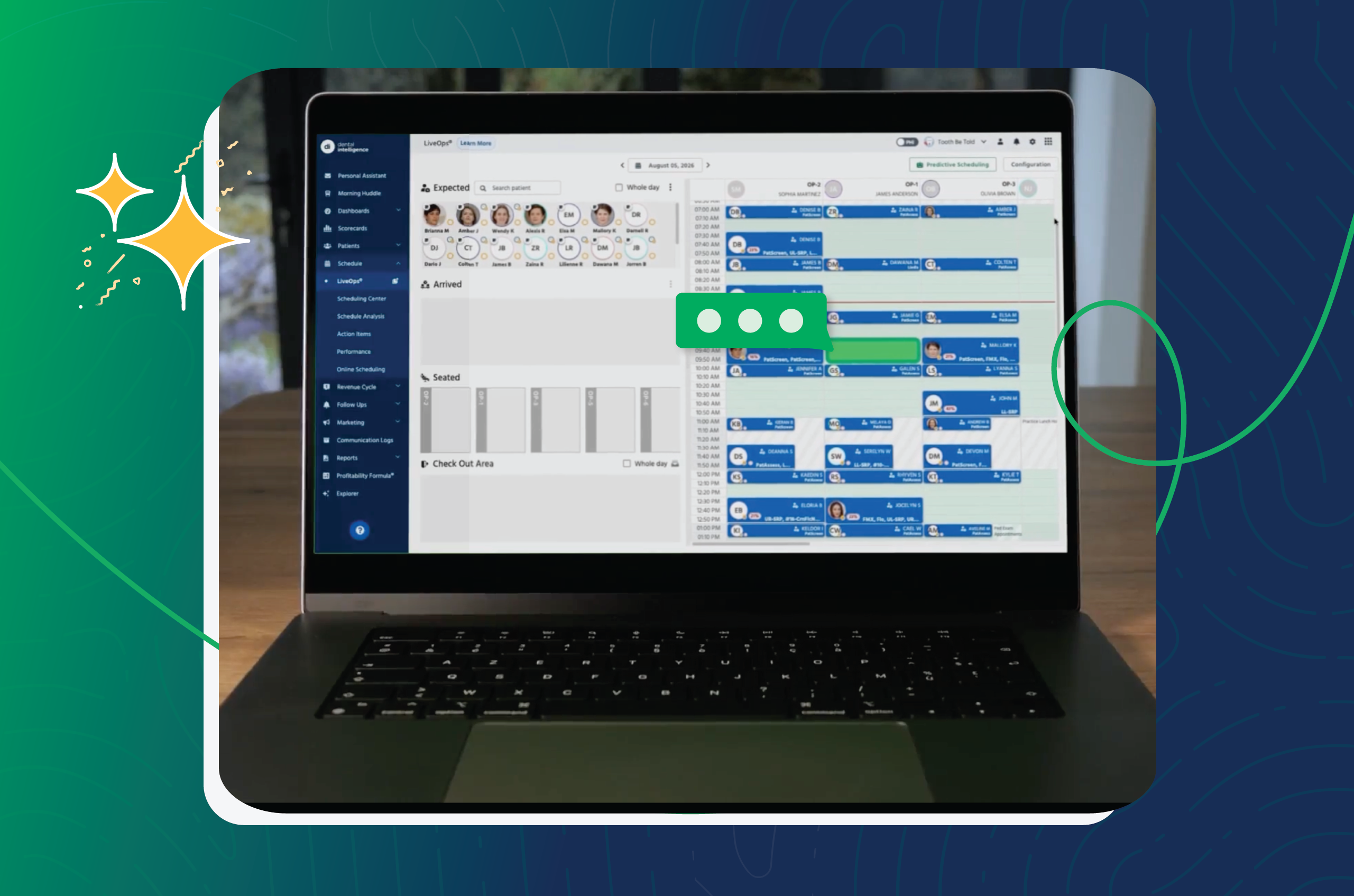
Predictive Scheduling is the part of Dental Intelligence Online Scheduling built to keep your calendar full without anyone having to watch it. It reads your schedule days in advance, spots the openings that quietly drain production, and matches each one to a patient who's likely to say yes and show up. And, as always, you set the limits and rules you want.
A chair doesn't always empty out the same way, and that's where most tools come up short. Predictive Scheduling recognizes three separate versions of the problem and handles each on your terms.
- The slot that's simply open: a hole in next week's schedule with nobody in it. Predictive Scheduling looks a few days out (the exact range is yours to set), draws from your overdue patients, and offers the opening to the strongest candidate.
- The cancellation waiting to happen: the appointment that's on the books but hasn't been confirmed. Those are the ones that tend to disappear the morning of. Predictive Scheduling gets ahead of the doubt, securing a confirmed patient for that time so the slot holds either way and your core schedule stays intact.
- The flaky friend. Appointment confirmed, right? Maybe. But what if this patient has canceled confirmed appointments three times in the last year? Do you still trust it? Predictive Scheduling reads that risk early using our innovative Patient Scoring system. Then it quietly arranges a dependable backup, so a likely no-show turns into a kept appointment before it ever gets the chance to cost you.
Want all three running together, or just one handling a specific job? You decide what's switched on and how it acts.
Patient Scoring: Reach the Right Patient First
Filling a slot is the easy part. Filling it with someone who'll accept the invite and keep the appointment is where it gets hard, and that’s where Dental Intelligence earns its keep.
Predictive Scheduling scores every patient two ways:
- How likely they are to accept an opening (based on things like past acceptance and how overdue they are) and
- How likely they are to keep the appointment once it's on the books.
Based on those probabilities, we make sure the first texts go to the patients who make the most sense, so your team isn't working down a list and hoping for the best.
Even after all that, you remain in control of your schedule.
You set the rules. It follows them.
Automated scheduling touches the thing a practice guards most closely (the schedule), so staying in control is the whole point. You set the parameters, the services, the send times, how many patients get contacted per slot, and who's left off entirely. Predictive Scheduling only ever does what you've told it to, protecting your primary schedule while a backup fills in quietly behind it.
That's what makes this the rare kind of automation that hands time back to your team, with no new dashboard to babysit. The schedule fills itself. The front desk gets to focus on the patient in the chair instead of the holes popping up next week.
Every chair, working.
The chairs are the practice. When they're full of the right patients getting the care they're due, everything downstream gets healthier — production, recall, the rhythm of the day.
Predictive Scheduling makes a full schedule the default state, not the thing you fight for every morning. It means more support for your team, more time for your patients, and less pain from every empty chair.
.avif)




.avif)